

AGV Research Vehicle (2nd Generation)
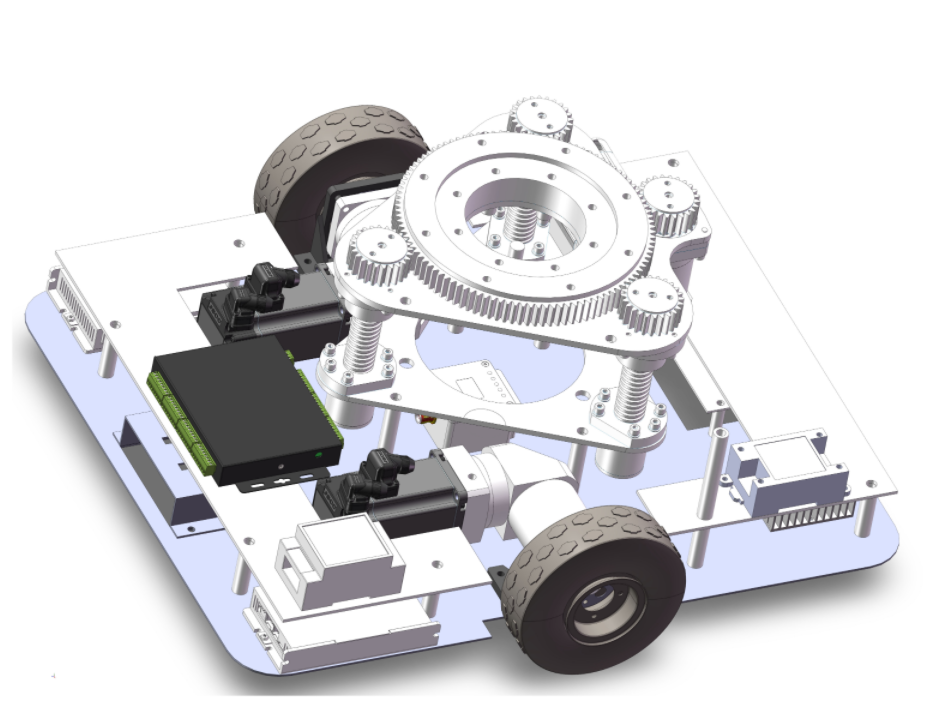
The 2nd-generation AGV research vehicle is an advanced mobile robotics platform that integrates high-load transportation, precision lifting, intelligent navigation, and flexible system control. It is specifically designed for research, prototyping, automation validation, and smart logistics applications, offering both high performance and strong scalability.
1. High-Performance Transportation & Lifting System
The vehicle is driven by a servo motor system with precision gearbox, ensuring stable and reliable motion control. It provides a maximum payload capacity of 400 kg, enabling heavy-duty material transportation in industrial and laboratory environments.
The integrated lifting mechanism, also powered by a servo motor with a high reduction ratio, supports a lifting capacity of up to 300 kg. It is suitable for material transfer, workstation docking, and automated loading/unloading operations.
To meet diverse operational requirements, the system supports multiple speed modes, including high speed, medium speed, low speed, and creep speed, ensuring optimal performance across different working conditions and safety levels.
2. Intelligent Navigation & Path Planning
The AGV adopts a QR code-based navigation system, enabling accurate path recognition and motion control. Users can easily configure and modify routes through an intuitive map editing system, allowing flexible deployment in various environments.
Based on the QR code map, the vehicle supports automatic path planning, enabling efficient point-to-point autonomous movement between predefined stations.
With integrated positioning technology, the AGV achieves high-precision docking accuracy of ±1 cm, ensuring reliable alignment with workstations and equipment.
3. Safety & Obstacle Avoidance System
The vehicle is equipped with an infrared obstacle detection system, capable of sensing obstacles within a range of 1 cm to 2 meters. During operation, the system automatically performs deceleration, stopping, and avoidance maneuvers to ensure safe and stable operation.
For enhanced operational flexibility, the AGV supports dual operation modes:
Automatic mode for fully autonomous task execution
Manual mode for commissioning, maintenance, or special scenarios
Manual control can be performed via a remote controller or touchscreen interface, enabling precise directional movement such as forward, backward, and turning.
4. Advanced Control & Process Automation
The system supports customizable action flow programming, allowing users to define sequences of operations including:
Station arrival and departure
Speed switching
Vehicle orientation adjustment
I/O signal control
Lifting actions
Multiple action flows can be combined into process-based tasks, enabling the execution of complex and continuous operational logic.
Additionally, the system supports special action insertion between adjacent points, making it ideal for repetitive workstations, process-specific steps, or localized control requirements.
5. Monitoring, Status Feedback & Operation Management
The AGV provides comprehensive real-time monitoring and status feedback, including:
Operating status
Task execution status
Obstacle avoidance status
Battery level
Fault and alarm information
This ensures efficient system management, quick troubleshooting, and reduced maintenance downtime.
The vehicle is also designed for long-endurance operation, capable of running for approximately 5 hours under a 100 kg load, supporting continuous operation in demanding environments.
6. System Integration & Expandability
The platform is built with a modular architecture and reserved interfaces, supporting extensive future expansion, including:
Magnetic track navigation (upgrade option)
Laser navigation system for complex environments
Upgraded obstacle avoidance (laser-based)
Multi-AGV scheduling and fleet management
Automatic charging system integration
The controller supports communication with external systems such as PLC, MES, and industrial controllers via Wi-Fi or RS485, using standard protocols including Modbus RTU and Modbus TCP.
In addition, the system supports I/O expansion, enabling integration with sensors, indicators, buzzers, and other peripheral devices, as well as signal linkage control for coordinated operation with production line equipment.
Conclusion
With its robust mechanical design, precise control, intelligent navigation, and strong expandability, the 2nd-generation AGV research vehicle serves as a powerful and flexible platform for smart manufacturing, research development, and automation innovation.